Saturday, 29 July 2023

Hannah Lamb - Fragment of a Dress Performance Piece

Jenny Skinner wearing Fragment of a Dress by Hannah Lamb after the performance
 

In 2022 the Bronte Parsonage Museum commissioned textile artist Hannah Lamb to create a piece for them.  That piece was Fragment of a Dress. Inspired by the museum's collection of small fragments of cloth associated with the Bronte family, especially Charlotte, and knowing that textiles and clothing are imbued with memories of special times in our lives, Hannah collected stories from museum visitors about items of clothing that they held dear. Each story took the form of a hand written note about the item and what it meant to them. Using these personal responses, Hannah and her students and colleagues stitched a series of embroidered panels onto silk organza, which Hannah then incorporated into the finished "Fragment of a Dress" which had a mid 19th century silhouette. It was on display at the Bronte Parsonage until the end of December 2022.

Here are some of the embroidered panels.  I would like to have seen what all the panels said.  I don't know if the panels were just a selection of the stories collected or all of them...


Hannah Lamb - Fragment of a Dress (embroidered panel detail)

Hannah Lamb - Fragment of a Dress (embroidered panel detail

Hannah Lamb - Fragment of a Dress (embroidered panel detail

On the 1 July 2023 in the Spinning Mill attic at Sunny Bank Mills in Farsley, Hannah & Jenny created a performance piece of the deconstruction of Fragment of a Dress, returning it to fragments.  The Spinning Mill attic is an empty space full of atmosphere...


Spinning Mill attic

Hannah's cyanotype prints of the embroidered skirt were on display and a soundtrack was playing in the background...


Hannah Lamb - Fragment of a Dress Cyanotype

Hannah Lamb - Fragment of a Dress Cyanotype


The dress, worn by Jenny Skinner, was cut into pieces by the audience.  This was achieved by Jenny handing a pair of scissors to each audience member, in turn, to cut a fragment after which Hannah stitched a certificate of authenticity onto each piece with her vintage hand operated sewing machine. Each fragment cutter could keep their fragment as a souvenir. The very first piece was cut by Hannah herself. She cut a sliver through several of the embroidered panels.  This seemed to give "permission" to cut a fragment however you chose.  Some cut slivers and some cut out whole embroidered panels.  These acts of deconstruction were filmed by Lucy Forrester of Proud Fox Studio.


Hannah Lamb's Vintage Sewing Machine


Hannah Lamb's Accoutrements

It was a very interesting performance - watching what people chose to cut and wondering what might become of the pieces.  I thought it was quite an act of faith on Hannah's part to see her beautiful and considered work "destroyed" in front of her (Hannah's use of the term "deconstruction" makes it seem less harsh).  I certainly found the responsibility of cutting into the piece a little unnerving.  I couldn't really concentrate on the soundtrack that was playing at the time and only caught "fragments" of what was being said.  I think it was the stories people had left her about their treasured clothing. 


Jenny Skinner & Hannah Lamb

A further performance happened later in the day.  I went to the first performance.  I particularly wanted to go to this as I hadn't been able to see the dress when it was on display at the Bronte Parsonage Museum.  I wanted to see it "whole" before it was deconstructed. I don't know if it is now completely "gone" or if there is more to fragment.  No doubt we will hear more from Hannah about its progress and I hope we will see the filmed outcome.   


I thought you might like to see the fragment I cut...

Fragment of a Dress: Fragment 3


I hope my fragment will go on to have a new life in something I make.


Saturday, 22 July 2023

More fabric necklaces head to cambridge contemporary crafts

Hippystitch Fabric Necklaces
 

This is just to let you know that a new selection of my fabric necklaces have made their way to cambridge contemporary crafts this week.  Can't decide which my favourite Liberty print is.


Go and take a look - cambridge contemporary crafts have lots of great things that would be perfect for a present or a treat. As well as jewellery, there are ceramics, prints and paper, sculptures, glass, textiles and cards. Find them at 5 Bene't Street, Cambridge, CB2 3QN.


Sunday, 16 July 2023

Ai Weiwei: Making Sense at the Design Museum, London

Ai Weiwei - Backpack Snake & Left Right Studio Material
 

Ai Weiwei: Making Sense is on at the Design Museum in London until 30 July 2023 so you've still got time to visit. The exhibition is a commentary on design and our changing values - have we just made technical progress or have we lost an element of craftmanship and cultural sensibility on the way? He explores the tensions between past and present, hand and machine, precious and worthless, construction and destruction.


The exhibit, pictured below, consists of 4000 Stone Age tools that Ai Weiwei found cheaply at fleamarkets.  Any one item could be a museum exhibit but here they are treated as ordinary - a layer of forgotten and undervalued history.  Consisting of axe heads, chisels, knives and wheels they are supposed to remind us that the origins of design are bound up with the need to survive.  This was my favourite piece...

Ai Weiwei - Still Life

This Bubble is the largest sphere it is possible to make in the kiln without it cracking...


Ai Weiwei - Bubble


The fragments in the foreground of the first picture are the remains of porcelain sculptures (see Bubble above) that were destroyed when his "Left Right" studio in Beijing was destroyed by the Chinese state in 2018.  He has turned this destruction into an exhibit.


Filling one wall of the gallery was Ai Weiwei's Lego Water Lilies, a recreation of Claude Monet's famous painting but using manufactured Lego bricks rather than brushstrokes.  Introduced into this reproduction of a "natural" landscape, which was in fact by constructed by Monet at Giverny, is a dark doorway (far right) which represents the door to the underground dugout where Ai and his father, A1 Qing, lived in forced exile in the 1960s.  Quite a contrast of landscapes!

Ai Weiwei - Water Lilies #1 (Lego)


Ai Weiwei - Water Lilies #1 (detail) Lego


There were two large snakes adorning the gallery walls - a Life Vest Snake (below) and a Backpack Snake (top).  The Life Vest Snake references the victims of the refugee crisis in Europe and the Backpack Snake the 2008 Sichuan Earthquake which killed many schoolchildren.  Made from everyday objects these sculptures draw attention to the disempowered in society...


Ai Weiwei - Life Vest Snake


The Nian Nian Souvenir bears the names of the 5197 schoolchildren that died in the 2008 Sichuan earthquake.  Each name is stamped in an ancient script using a hand-carved jade seal - see the detail below.  These were very beautiful. 

Ai Weiwei - Nian Nian Souvenir (detail)


One of the floor exhibits is made up of 200 000 handmade high quality porcelain balls.  They are cannonballs made during the Song dynasty (960-1279 CE).  Ai Weiwei was struck by the fact that such an apparently delicate material was once used as a war weapon...


Ai Weiwei - Untitled (Porcelain Balls) 


There was another exhibit from the Song dynasty which consisted of 250 000 spouts from handmade teapots and wine ewers.  If the pots were not perfect the spout was broken off.  This gives an indication of the scale of the porcelain industry at that time. Ai Weiwei also sees it as a commentary on freedom of speech or lack of it with the spouts/mouths removed.


Ai Weiwei - Spouts

Ai Weiwei - Spouts (detail)


The success of this exhibition lies in the scale of the exhibits.  I think a single item would have much less impact than the many from Ai Weiwei's varied collections that are displayed here. There was plenty more to see but it's not a huge exhibition so you're unlikely to get gallery fatigue. The Design Museum has an interesting shop but no cafe, although there are plenty nearby.  


Well worth a visit - go see if you can!

Tuesday, 27 June 2023

The 62 Group - Tailored - Sunny Bank Mills, Farsley, West Yorkshire


Sian Martin - Process (detail) & Hannah Lamb - Deconstructed Shirt (detail)

The 62 Group, a renowned textile art collective, are currently exhibiting at Sunny Bank Mills with an exhibition entitled - Tailored.  The work in Tailored explores multiple meanings and interpretations of the word itself and what it means to the individual artists’ practice. Some artists consider the process of making and elements of it; the design and weaving of cloth and the pattern, pinning, cutting and sewing of a garment. Other artists take a more narrative and personal approach to the meaning. The techniques used include stitch, knit, casting, drawing and film; sculpture and installation.  The exhibition is also a celebration of 10 years of culture at Sunny Bank Mills where cloth was produced that was used primarily in the making of suits.

I'm going to give you a whistlestop tour through some of my favourites...

Sian Martin - Process

Sian Martin's Process (above & detail at top) is inspired by one of the mill workers at Sunny Bank Mills and Sians's own beginnings in dressmaking.  Sian was fascinated by tailor tacks and their ability to transfer marks through layers of cloth.  This piece celebrates those traditional dressmaking skills.   Also the repetitive and rhythmic stitching of this piece celebrates that stage in the process of making a tailored garment.


Hannah Lamb - Deconstructed Shirt & Dressing Up

Hannah Lamb's work is always interesting.  Taking a vintage man's shirt, with it's overtones of  masculinity, formality and appropriateness, Hannah has used a devore technique to deconstruct it and to question whether those overtones are valid or a camouflage behind which someone is hiding.  In Dressing Up, Hannah has developed this theme further using cyanotype imagery of the Deconstructed Shirt to suggest the different layers of our private and public selves.  The mannequin between the images offers a different body image playing with ideas of size, gender and identity.  Are we dressing to fit in or express our true selves?


Hannah White - Fluidity & Rigidity: No 4 

Hannah White "tailors" her weaving into a customised, sculpted form using conductive threads and a process called electroforming. This creates a metal skeleton on the conductive threads around which the fabric folds. Hannah describes this as engineering with thread.  I don't pretend to know how this actually works but would like to know more about the process and even see it in action.  The results are impressive.


Teresa Whitfield - Woollen Stockings for the Mending Girl

Teresa Whitfield was inspired by a circular knitting machine at Sunny Bank Mills.  Typically they were used for knitting worsted stockings but the one here in Farsley was actually used for knitting dyed samples that would be used for the woven cloth.  Here she imagines it used for knitting some stockings for one of the female mill workers and wonders about their living and working conditions and the inequalities of the textile industry.  Her work is a drawing of knitted fabric.  Teresa sees a parallel between the repetitive and meditative act of drawing knitting and of the act of knitting itself.


Shuna Rendel - Thread in the Air (detail)


Shuna Rendel has the Asian tailorbird as her inspiration.  This small creature stitches together leaves using spiders' web or plant fibres to make a cradle for its nest.  Shuna has created a series of possible cradle variations using avocado skins, vine tendrils, gladioli sepals, vetch pods and waxed linen thread.


Ann Goddard  - Tailor-Made

Ann Goddard was also inspired by the tailorbird and by the bespoke clothing made by Master Tailors.  Both the bird and the Master Tailors create something that will blend into the environment of the user.  Here Ann used the pockets of a pinstripe suit, the fabric of which was similar to that woven at Sunny Bank Mills, as the cradle for the nest which is represented by the abaca fibre inside.  The suit used was made by Master Tailor Beno Dorn who btw made the first suits worn by the Beatles.

There are plenty of other interesting pieces in the exhibition.  This is just a small taster.  You'll have to be quick to catch this one as it closes on 2 July 2023.  Do go if you get the chance.

Sunny Bank Mills is a great place to visit.  Apart from the Gallery and shop on site, there are various cafes, a Scrap Shop, the Sunny Bank Mills Archive, artists studios, shops and more.  There's also plenty of car parking.

Saturday, 24 June 2023

Jeanette Orrell – Drawings on Indigo - Ruthin Craft Centre, Wales

Jeanette Orrell - Untitled (Indigo blanket) XIV

I have long wanted to visit Ruthin Craft Centre. I have read about their exhibitions, particularly their textile and mixed media exhibitions, and wished I was a little closer and able to visit. Having seen that Jeanette Orrell was exhibiting, I made arrangements to go - and was not disappointed.

Jeanette Orrell was born in Leigh, Lancashire in 1964 but has lived in Wales for more than 20 years. Originally trained in ceramics at Camberwell School of Art, following graduation she travelled between London, Japan and Greece before returning to the North West to continue her art and bring up a family. In 2017 she was awarded an Arts Council of Wales Creative Wales Award to study indigo dyeing on a farm in the foothills of Mt Fuji in Japan. Orrell brings fine art and craft together informed by familial ties, making, nature and motherhood.

Jeanette Orrell - Untitled (Indigo blankets) & Untitled 
(Indigo plant drawings) I-VII

Orrell's work combines a daily drawing practice with the art of indigo dyeing. This particular body of work was developed following the death of her father and contemplates mourning, recovery and regrowth. Jeanette found she had chosen a tradition that has a longstanding connection with mourning. Indigo was woven through the funerary wardrobe of Tutankhamun, the hand dyed ikats of Central Asia and the uldebe funerary cloths of the Dogon people of West Africa Here abstracted botanical forms are painted on to woollen fabric with a resist paste and then dyed in indigo. Dyeing a single blanket can take days. There are also hand stitched appliqued botanical collages using naturally dyed linens...


Jeanette Orrell - Blue Poppies I & II

Whilst the work employs simple forms they are stunning and the large indigo blankets are breathtaking. I also found the samples and ephemera that were exhibited fascinating...

Jeanette Orrell - Samples, notebooks & ephemera


Jeanette Orrell - Samples & ephemera


I loved the indigo samples where white thread had been couched down to form elaborate patterns...

Jeanette Orrell - Indigo sample with couched white thread

There were also a number of short films made by Jeanette's daughter, Ellie Orrell, illustrating Jeanette's practice. This exhibition continues to 2 July 2023. Jeanette and Ellie Orrell are running a two day indigo dyeing workshop at Ruthin Craft Centre on 1-2 July 2023. You can book here.

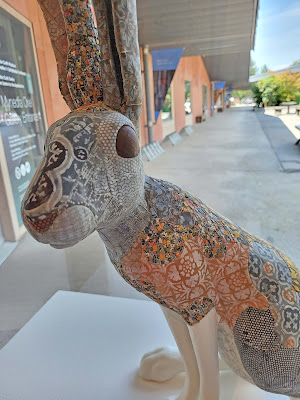
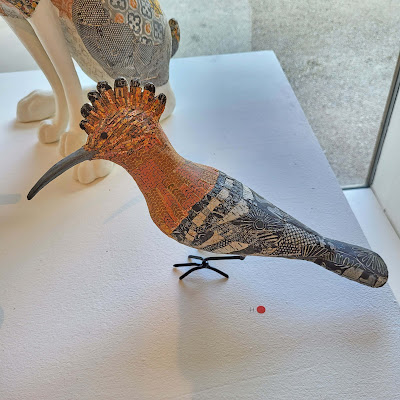
Other exhibitions on show were Animal Rites - celebrating fauna in clay. I loved Susan O'Byrne's work which looked like patchwork...

Susan O'Byrne - Hare 2023
(Hand built and printed paper porcelain)

Susan O'Byrne - Hoopoe 2023

and Louise Bell's Endangered Species that looked like pull-along toys. Louise fears these representations may be all that is left if humans don't change their actions in relation to these animals.

Louise Bell - Black Rhino 2023

Love the angels coming out of the elephant's trunk...

Louise Bell - Elephant Finding Hope 2021

All of Louise Bell's work was fantastic.

The other exhibition was Zoe Preece - In Reverence. Zoe Preece has created a series of ordinary domestic objects – intricately carved by hand from porcelain or turned from plaster on a lathe. Each piece takes many hours to create. For Preece, the repetitive and unseen activity of her craft resonates with the ceaseless, invisible domestic labour undertaken within the home. It is this often unnoticed, undervalued work that Preece tries to capture in this installation.


Zoe Preece - Spoonful


Zoe Preece - Carved Tools


Ruthin Craft Centre has a large car park and a spacious cafe. If you need somewhere to stay try Manorhaus Ruthin - nice rooms, lovely food & great welcome from Gavin. Also, lovely to see Julie Arkell and Dionne Swift represented in the artwork on display at Manorhaus.


Sunday, 16 April 2023

New fabric necklaces head to cambridge contemporary crafts

Hippystitch Liberty Print Fabric Necklaces
 

A new selection of fabric necklaces have winged their way to cambridge contemporary crafts recently.

Hippystitch Liberty Print Fabric Necklaces


There are lots of lovely Liberty prints to choose from...

Hippystitch Liberty Print Fabric Necklaces


Why not go and take a look? cambridge contemporary crafts have lots of great things that would be perfect for a present or a treat.  As well as jewellery, there are ceramics, prints and paper, sculptures, glass, textiles and cards.  Find them at 5 Bene't Street, Cambridge, CB2 3QN.


Monday, 10 April 2023

Wilhelmina Barns-Graham - Hatton Gallery - Newcastle upon Tyne

Wilhelmina Barns-Graham
 
Wilhelmina Barns-Graham (1912-2004) was a Scottish artist who became a leading member of the St Ives School of artists. This exhibition - Paths  to Abstraction - at the Hatton Gallery in Newcastle upon Tyne concentrates on her work from 1935-1972.  During this period her work develops from the representational to the abstract.


Wilhelmina Barns-Graham - The Episcopal Church, Aviemore 1938


Wilhelmina Barns-Graham - Sleeping Town 1948

Colour was very important to Barns-Graham.  She often associated a particular colour with people, places, names or letters which was characteristic of her synaesthesia.  The colour red runs through a number of her works...

Wilhelmina Barns Graham - Snow at Wharfedale 1957

Wilhelmina Barns-Graham - Red Square 1954

Wilhelmina Barnes-Graham - Artist's Materials etc.

In 1949 Barns-Graham visited Switzerland and the Grindelwald Glacier which had a profound impact on her resulting in the Glacier Series which she continued to paint until the early 1950s. These shows her increasing interest in geometry and her aim to capture the scene in form and colour which continued in her Rock Form Series based on the Cornish landscape...

Wilhelmina Barnes-Graham - Glacier Chasm 1951


Wilhelmina Barnes-Graham - Three Rock Forms 1951


Her notebook and photos from her time in Switzerland were on display...

Wilhelmina Barnes-Graham - Notebook & Photos


In the 1960s, Barns-Graham's work became more abstract featuring squares and circles...

Wilhelmina Barnes-Graham - Untitled 1958


Wilhelmina Barnes-Graham - Assembly of Nine 1964


Wilhelmina Barnes-Graham - In Tension 1968


My favourite painting in the exhibition was "Snow at Wharfedale" and in general the semi-abstract forms of Barns-Graham's work in the 1950s.

Go check it out. It's on until 20 May 1923 so there's still time!