Showing posts with label Fashion and Textile Museum. Show all posts

Sunday, 31 August 2025

Textiles: The Art of Mankind at the Fashion & Textile Museum, London

Wodaabe Artisans - Young Woman's Wrapped Skirt (detail) 

The main exhibition on at the Fashion and Textile Museum, London is Textiles: The Art of Mankind. This exhibition celebrates the ancient relationship between textiles, people and the environment. Amazing textile techniques that have been developed across the world are illustrated.  It shows skills handed down through generations, and illustrates people's thoughts and histories.  It is organised through themes of materials, identity, collaboration, and sustainability.  Here is just a flavour of the items on display.


The Wodaabe skirt above is embroidered in chain stitch in patterns meaningful to these migratory people.

Tuvalu - Pandanus Skirt for the traditional Te Fatele song/dance

This skirt from Tuvalu, a pacific Polynesian island, is coloured using natural dyes including bark juice, burnt nut soot and turmeric root. 


Grace "Molly" Crowfoot - Peruvian Backstrap Loom Model

The above piece of double weave cloth was made by Crowfoot in the 1920s to understand ancient textile techniques.  Crowfoot could be described as a English textile archeologist.


French Basketmaker - Nest Basket

Inspired by birds' nests, this basket by a French basketmaker, uses twigs, branches, wire and nails. 


Chinese Artisans - Baby's Tiger Hat

Made in the early 1900s, this tiger hat has moveable tassels that would move with the baby's head.


Sara Impey - Why Stitch?

Sara Impey's piece Why Stitch makes an argument for the importance of textiles. One of the quotes stitched on this, which resonates with me - "Anyone who loves textiles, touches them. It is an instinct" - Jessica Hemmings 2012. That's just so true - they are so tactile.  Sara's artwork is made from calico fabric with free-motion machine-stitching and machine-quilting with polyester thread.


Bogolanfini Cloth

Bogolanfini cloths are worn by hunters as camouflage, for status and as ritual protection or by women as they reach adulthood or after childbirth.  Traditionally these cloths were woven by men on narrow looms and dyed by women.

Tadek Beutlich - Figures in Cocoons 2

Made from PVA soaked cotton wool, modelled over a woven structure of esparto grass, this piece features helpless people, and is supposed to reflect the trauma of war.


Jo Ann C Stabb - Swan Song - My last academic plan ever

This wearable art coat is made from appliqued recycled industrial silk scraps with dollar signs hand embroidered round the bottom to signify "the bottom line".  The inside is stamped with the different stages of the academic planning process.

English Artisan - Sweet Bag

This drawstring bag is an example of goldwork from the mid 16th Century and has intertwined hearts on the front, a symbol of love and devotion.

Rajasthan Dyer - Just dyed cotton cloth

This cloth from India is an example of tie dyeing from the 1980s, that has been dipped several times.  The patterns are supposed to evoke the waves formed by winds blowing across the desert sands. 


Lynne Setterington - Been Shopping

Reflecting on our preoccupation with retail therapy, Setterington has created this piece from Suffolk puffs made from plastic carrier bags that reflect her own retail preferences.  More of Lynn Setterington's work is on display in the Connecting Threads exhibition in the Museum's Fashion Studio and is really interesting.  For more on that click here.

Both exhibitions are on until Sunday 7 September 2025. There is no cafe in the Fashion and Textile Museum but there are plenty close by and the Museum does have a shop.  London Bridge station is a short walk away.


Monday, 25 August 2025

Connecting Threads - Lynn Setterington at the Fashion & Textile Museum, London

Lynn Setterington - Respect + Protect - 2009

On a recent trip to London I went to the Fashion & Textile Museum to see Lynn Setterington's Connecting Threads exhibition in the Museum's Fashion Studio. Lynn is a socially engaged textile artist who has worked with many different communities to co-create textile pieces that bear a message.  Here's a flavour of Connecting Threads.

The picture above is the result of an Arts & Science partnership project with Professor of Microbiology at Manchester Metropolitan University (MMU), Joanna Verran.  Working with different communities across Manchester, they produced this quilt for World Aids Day in 2009. Paricipants added red cross stitches to this piece  which acts as a reminder that the virus continues to affect people's lives.

This is one of Setterington's early embroideries, rooted in place and representative of everyday life...

Lynn Setterington - Leeds Market - 1984
Hand & Machine Embroidery

A number of Lynn's textile projects have been influenced by the signature quilt or cloth.  These items date back to the first half of the 19th century in the USA and initially bore the names of families and friends. Later, the signature quilt/cloth was used as a means of fundraising for good causes or particular projects.  People paid to sign their name on cloth which was then embroidered creating a finished piece bearing embroidered supporters' signatures. 

"Remembering Emily" was made to commemorate Emily Wilding Davison, a suffragette who was accidentally killed by the King's horse at the Epsom Derby, whilst trying to make her protest. One hundred years later, Setterington got staff and students at MMU to embroider their names on cotton fabric which were later machine stitched together into a 10m long banner...

Lynn Setterington - Remembering Emily - 2013

In "Signature Bags", these bags bear the names of members of Katab, a group of textile artisans, in Ahmedabad, India.  Made from khadi cloth, these bags, by bearing names, acknowledge the makers whose skills and work so often go unidentified...

Lynn Setterington - Signature Bags - 2011
 
"Threads of Identity" was made to commemorate the death of Ahmed Iqbal Ullah, a young boy killed in 1986 as a result of a racially motivated crime at a school in south Manchester. Working with 16 boys from Burnage Academy, Setterington got them to collect the names of 10 people important in their lives and to embroider these names on white cotton handkerchiefs within the letters spelling Burnage Academy 4 Boys. These were then stitched together using a faggoting machine to create the wall hanging, shown below, that has been on display at the school ever since...

Lynn Setterington - Threads of Identity - 2016

This piece, made by Setterington, draws attention to the Construction industry which has the highest suicide rate of any sector...

Lynn Setterington - Pearly King of Eccles

The "World Wellbeing Map" is a comment on climate change.  Made by over 100 people learning English at Oldham Library and MMU students, it highlights rising sea temperatures.  Made by hand, it upcycles products from the construction industry - thread from discarded debris netting stitched into rendering mesh...

Lynn Setterington - World Wellbeing Map - 2024

Setterington has also used the Suffolk Puff or YoYo (American) 
in many of her pieces. These are gathered circles of fabric that make a decorative rosette. Below is "House" made from debris netting gathered up into Suffolk puffs and stitched together, commenting on the housing crisis, lack of affordable homes and poor mental health of construction workers...

Lynn Setterington - House (detail) - 2024

Made during the Covid Crisis, "Living with Loss", apes historic samplers but with a modern twist by repurposing materials from the construction industry.  The loss of a loved one is something we all have to face at some time in our lives.  The unfinished nature of the piece is purposeful...

Lynn Setterington - Living with Loss - 2020

This is a really interesting exhibition and there are also some short films about some of the projects exhibited here but also about a project, Sew Near - Sew Far (2017), developed with the Bronte Museum in Haworth, Yorkshire. Here the pseudonymous male signatures of the Bronte sisters (Acton, Currer and Ellis Bell), found at the museum, were writ large on Haworth Moor where it could be read by walkers on the Bronte Way.  The signatures were made from debris netting which themselves contained the stitched signatures of participants in the project.  These signatures were stitched into the debris netting with a wool and string mix. 

This exhibition is on until Sunday 7 September 2025 in the Museum's Fashion Studio, which is sometimes closed for special events and workshops, so please check ahead if you want to be sure of access.  There is also a Connecting Threads book by Setterington, on sale in the museum shop, which is an interesting read.

Textiles: The Art of Mankind is in the main gallery - blogpost coming soon.

There is no cafe in the Fashion and Textile Museum but there are plenty close by and the Museum does have a shop.  The Museum is a short walk from London Bridge station.


Friday, 1 September 2023

Andy Warhol at the Fashion & Textile Museum, London


Andy Warhol - Textile with Acrobats, Clowns & Horses (detail)

Andy Warhol: The Textiles is currently on display at the Fashion & Textile Museum in London until 10 September 2023.  In the 1950s, before Warhol's career as a fine artist took off, he was a very successful commercial illustrator and graphic designer and designed many commercial textiles. 


Andy Warhol - Textile with Acrobats, Clowns & Horses
(blue-green, red-pink & yellow-lilac colourways)

The word that immediately came to mind whilst looking at Warhol's textiles was "charming".  The designs have a coherent style, are whimsical, colourful and haven't dated. The blotted, broken line outline of his designs was a signature trait.  The textile with Acrobats, Clowns and Horses is a border print with a sequence where the clown somersaults from horse to horse.


Andy Warhol - Happy Bug Day
Printed cotton beach costume - brown, orange & yellow colourway
 

Warhol's most successful commercial design, inspired by the 18th and 19th century mounted displays of insects, was Happy Bug Day for Fuller Fabrics.  It was also used for cards stationery and wrapping paper.  He produced similar designs concentrating entirely on butterflies in both muted (Happy Butterfly Day) and bolder colours (see below)...


Andy Warhol - Textile with Boldly Coloured Butterflies
Printed Silk Blouse

Many of Warhol's designs feature fruit, and lemons were a particular favourite...

Andy Warhol - Textile with Lemons
Bolero - Printed cotton

Being a stationery fiend, I particularly liked this design featuring pens, pencils and paintbrushes.  Here Warhol uses his characteristic blotted, broken line technique to feature the tools of his trade...

Andy Warhol - Textile with Pens, Pencils & Brushes

He used everyday items such as socks, boots, shoes, brushes and brooms, gardening themes, pocket watches, luggage and buttons in his designs...
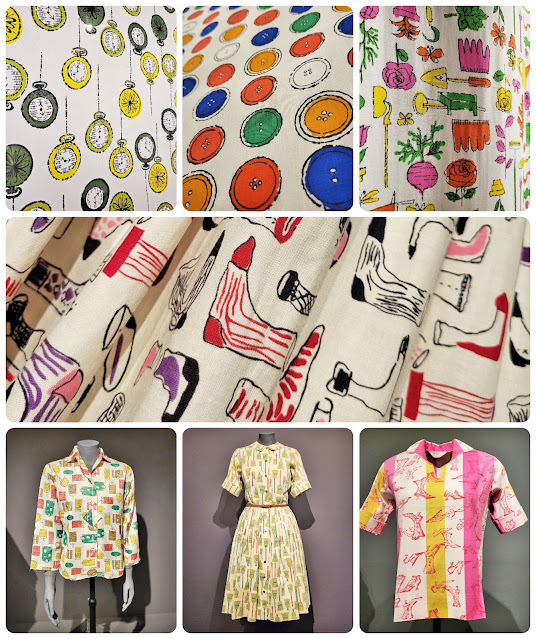
Andy Warhol - Collage of Designs
Pocket Watches, Buttons, Gardening, Socks, Luggage, Brushes & Brooms, Boots & Shoes


In the early 1960s Warhol sold his last three known textile designs of ice cream cones, pretzels and candy apples to the Stehli Silks Corporation.  Those shown below were all made from the designs printed on polyester.
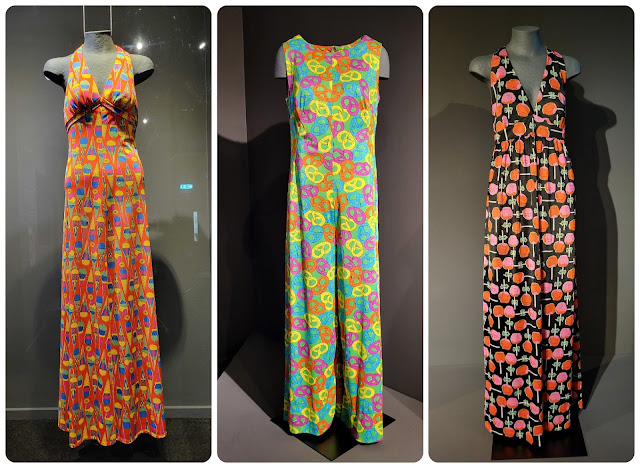

Andy Warhol - Ice Cream Cones, Pretzels, Candy Apples
Polyester Evening Dress, Polyester Culottes, Polyester Evening Dress

So if you want to be charmed, go take a look but remember this exhibition is closing on the 10 September 2023. I didn't know about this aspect of Warhol's work and it was great to see.  The Fashion and Textile Museum is in Bermondsey (south of the river - nearest station is London Bridge) and there are lots of cafes and restaurants nearby.  It's just near the White Cube Bermondsey if you fancy a look round there too.

The Fashion & Textile Museum has a resources room so if you fancy spending a bit of time making your own Andy Warhol style print, you can...


Andy Warhol Inspired Print


Do go if you get the chance!


Monday, 8 February 2016

Liberty in Fashion - Fashion and Textile Museum, London

Elsie & Felix & typical Liberty florals

This exhibition at the Fashion & Textile Museum in London showcases Liberty clothes and textiles from 1875 when Arthur Lasenby Liberty opened his first store on Regent Street.  It explores Liberty's impact on fashion in the 19th and 20th centuries and its collaborations with designers and other brands.

Liberty embroidery

Liberty produced embroidery designs which could be used as an economic way to embellish clothes.

Smock detail

Liberty was also responsible for the rediscovery of some traditional crafts.  Smocking was one of these and became one of its trademark looks.  Kate Greenaway, children's illustrator and author was closely associated with Liberty's children's wear and her illustrations often depicted children in smocked dresses. 

Smocked Child's "Mab" Dress by Liberty & Co.

In the 1960s Liberty's fabrics were used by many of the new designers who were located around Carnaby Street and brought a particular "Englishness" to their look.

Liberty prints deigned for the Dolly Rockers label in the 1960s

The 1970s nostalgia for the past meant Liberty's floral prints fitted the mood well.
 
1970's Nostalgia

Liberty continues to collaborate with other designers and brands ...

Cacharel 2004

Cacharel 2004
Nike X Liberty 2015

If you love Liberty go take a look.  The exhibiton is on until 28 February 2016.