Sunday, 26 March 2023

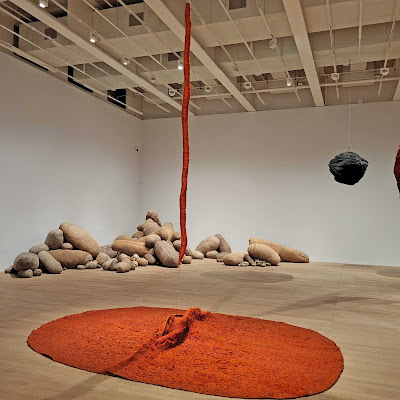
Cecilia Vicuña - Brain Forest Quipu at Tate Modern Turbine Hall

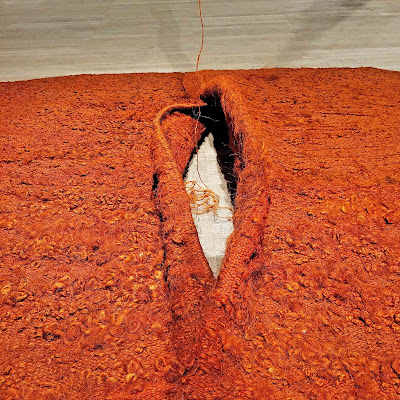
Cecilia Vicuña - Dead Forest Quipu (detail)
 

Chilean artist & poet, Cecilia Vicuña, is currently exhibiting her Brain Forest Quipu in the Turbine Hall at Tate Modern, London.  Her installation references the Andean Quechua people's use of the quipu or knot, used instead of writing to record and remember things such as statistics, poems and stories.  Vicuña calls the quipu "a poem in space". They originated 5000 years ago and were banned after the European conquest in the 16th century. Many were burnt and destroyed at that time but their symbolism remains part of Andean culture today although the exact meanings behind their formations and colours is not now known.


Cecilia Vicuña - Dead Forest Quipu (detail)

Cecilia Vicuña - Dead Forest Quipu (detail)

Cecilia Vicuña - Dead Forest Quipu (detail)

This multimedia installation is an act of mourning for the destruction of the rainforests and its subsequent effect on climate change and the violence against indigenous peoples.  The installation comprises 3 elements. Firstly, two Dead Forest Quipu sculptures which are 27m textile pieces hanging from the ceiling.  These include different materials woven together with found objects, unspun wool, plant fibres, rope and cardboard. Then there is a Sound Quipu including indigenous music, silences, new pieces by Colombian composer Ricardo Gallo and field recordings from nature. And lastly a Digital Quipu which shows films of indigenous activists and land defenders from around the world who are using digital platforms to get their voices heard.


Cecilia Vicuña - Dead Forest Quipu (detail)

Cecilia Vicuña - Dead Forest Quipu (detail)

Cecilia Vicuña - Dead Forest Quipu (detail)

Some of the items included in the sculptures were collected from the banks of the River Thames by women from local Latin American communities.  This is typical of Vicuña's use of modest, imperfect found materials which she calls "precarios" (precarious)


Cecilia Vicuña - Dead Forest Quipu (detail)

Cecilia Vicuña - Dead Forest Quipu (detail)

The 
bone white colour of the sculptures evokes the bleached bark of trees killed by drought or intentional fire or other dried out substances like snakeskin.

Cecilia Vicuña - Dead Forest Quipu (detail)

I saw this when also visiting the Magdalena Abakanowicz exhibition - plenty of textile art on show to whet your appetite! 

The Cecilia Vicuna exhibition is on until 16 April 2023.


Saturday, 18 March 2023

Creature Comforts at JGM Gallery, London

Woojin Joo - Re-New
 

Way back in December 2022 I went to the JGM Gallery in Battersea, London to see the Creature Comforts exhibition.  This was a textile exhibition exploring the multifaceted aspects of textiles - comfort, chaos and conflict.  It was great and here are my highlights...

Woojin Joo - Glove Dokkaebi

Woojin Joo's work is inflenced by the East Asian culture she grew up in. Her pieces were unusual and fascinating using lots or free machine embroidery.  Her Glove Dokkaebi was a creature made from a lost glove. Dokkaebi are Korean mythological creatures like a kind of goblin. It is believed they are formed by the spiritual possession of an inanimate object like a lost glove.  They are thought to be able to interact with humans to play tricks on them or to help them.  

Woojin Joo - Ten Symbols of Longevity (detail)


Freddie Robbins had both machine knitted and hand knitted pieces.  I liked how the handknitted word "courage" cast its shadows...


Freddie Robbins - Be Afraid

Freddie Robbins - Courage


I loved the bright colours and graphic style of Martin Maloney's embroidered piece. This was embroidered in Afghanistan using one of Martin's collages as the design...

Martin Maloney - Red Velvet (detail)


Molly Kent's weaving had a dramatic quality...

Molly Kent - Stuck in Limbo


Alice Kettle's distinctive style of hand and machine stitch was in evidence here...

Alice Kettle - Lady With A Bowl


The exhibition closed in January but you can get a flavour of it here.


Saturday, 11 March 2023

Annie Montgomerie - Hand Me Downs - Yorkshire Sculpture Park

Annie Montgomerie - Giraffe

Annie Montgomerie's anthropomorphic creatures capture a sense of nostalgic childhood when children played hide and seek, skipped along the pavement, explored the woods whilst wearing hand me downs from their siblings and couldn't keep their socks up.

Annie Montgomerie - Toftly the Dog

Annie Montgomerie
- Urshalla the Cat

Cats, dogs, foxes, alpacas, bears and more appear in her collection and often have a special "loved" toy with them. 


Annie Montgomerie - Alpacas, Bombom the bear, Locka & Eztree the foxes

Her making starts with the face which she creates from muslin and glue until she has a hard outer shell whilst the body and clothes of her creatures are made from vintage finds. Annie says, "I use muslin, 100% wool felt, ‘up-cycled’ wool garments, velvet, leather, cotton, moleskin and blankets for wall hangings and figures. I then stitch on curious little things I find including vintage buttons, charms and jewellery."

Annie Montgomerie - Agny the Sun Bear

Annie Montgomerie - Blip the Mouse

They are skillfully made and spookily realistic. I found them rather unsettling but fascinating.


Annie Montgomerie - Fizzle the Owl

Annie Mongomery - Pidge the Pigeon


The Hand Me Downs exhibition has closed now but was at the wonderful Yorkshire Sculpture Park which is always a great day out.


Sunday, 5 March 2023

New Liberty Print Necklaces Available in my Folksy Shop

Liberty Print Fabric Necklaces
 

This is just to let you know that I've restocked my Folksy shop with some new Liberty print fabric necklaces.  You can find them here.  

Liberty fabrics

And here's a closer look at the fabrics I've used.  There's traditional, geometric, floral, bold, graphic, whimsical, bright - in fact something for everyone!  There's a bit more detail about the prints over on Folksy.  I was particularly pleased to find the Pattern Map fabric below.  Who doesn't love a nice map - particularly one illustrated like this.


Pattern Map Fabric and Necklaces

All the necklaces are made with Tana Lawn which is a beautiful soft cotton that feels great against the skin.  You can tie the necklaces with a bow or a knot and vary the length from choker to mid chest depending on what you're wearing.  They can even be carefully handwashed.  What's not to love!

Liberty Print Fabric Necklaces

Do hop over to Folksy and take a look...

Liberty Print Fabric Necklace in Pietra Dura Print


Saturday, 18 February 2023

Magdalena Abakanowicz at Tate Modern, London

Magdalena Abakanowicz - Abakan January-February

This exhibition - Every Tangle of Thread and Rope - is definitely not to be missed.  If you can get there - GO!  Magdalena Abakanowicz (1930-2017) was a Polish artist, most well known for her monumental woven structures of the 1960s and 1970s known as Abakans, which were named after her.   

Magdalena Abakanowicz - Design for Tapisserie 21 Brune

She studied painting and weaving at the Academy of Fine Arts in Warsaw, graduating in 1954.  At this time the Soviet regime was becoming more liberal and there were funding opportunities for craft and folk art through the state sponsored Association of Polish Artists which she took advantage of.  Artists designed items that were then produced by artisans.
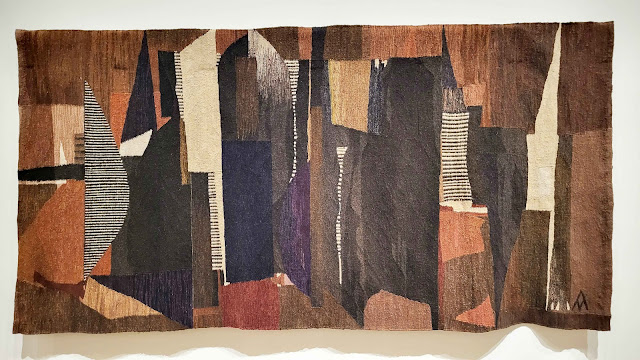
Magdalena Abakanowicz - Tapisserie 21 Brune
(Woven by Maria Lydzba)

She lived in a studio apartment in Warsaw with her husband where creating artworks that could be folded up was a distinct advantage.  Her style of weaving was improvisatory.
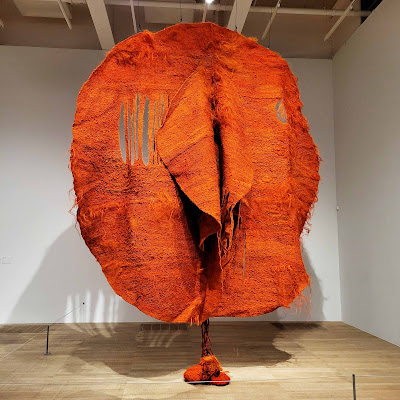
Magdalena Abakanowicz - Abakan Orange (1968)


She saw a strong connection between her work and the natural world, seeing fibre as the basic element making up the organic world.  She said "It is from fibre that all living organisms are built, the tissue of plants, leaves and ourselves... our nerves, our genetic code, the canals of out veins, our muscles...We are fibrous structures."
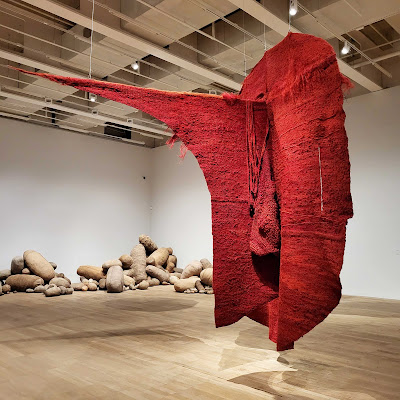
Magdalena Abakanowicz - Abakan Red


Her weavings use sisal and sometimes wool, horsehair and rope and move from the rectangular to the more organic 3D free-hanging Abakans. Referring to her installations as "environments" Abakanowicz was interested on the immersive and performative possibilities of her arrangements in particular spaces and liked to light them dramatically.
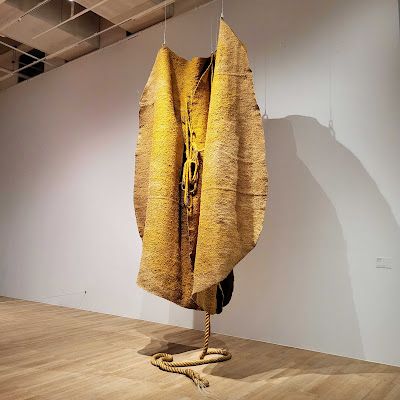
Magdalena Abakanowicz - Abakan Yellow


Magdalena Abakanowicz - Abakan Orange (1971)


Magdalena Abakanowicz - Abakan Orange (1971) detail

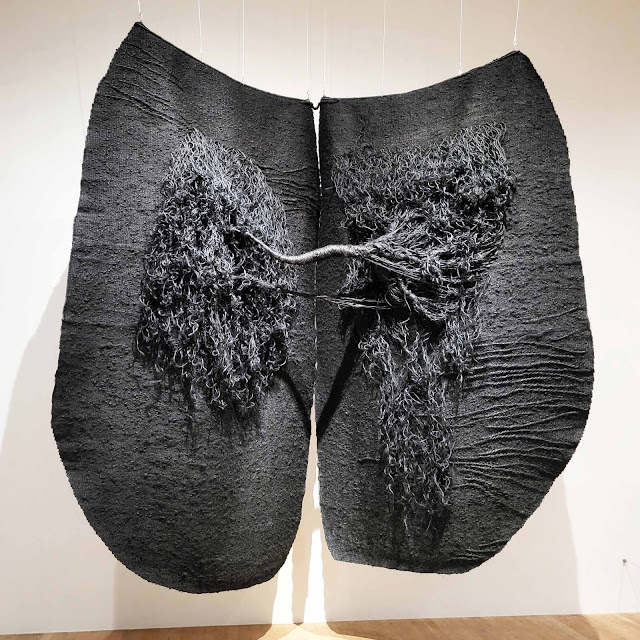
Some of her works bring to mind garments and others body parts with elements spilling out of them.  I think her Abakan January-February (see first image) looks like a pair of lungs.

Magdalena Abakanowicz - Situation Variable 2

Abakanowicz's work brought to mind that of Sheila Hicks who was also making remarkable textile art in the same period and upto the present. (You can read more about Hick's exhibition "Off Grid" at The Hepworth, Wakefield in 2022 here). 
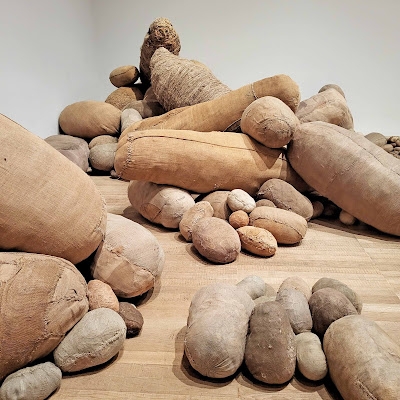
Magdalena Abakanowicz - Embryology 


In the 1980s Abakanowicz began to move away from the exclusive use of fibres and never liked being referred to as a fibre artist.  
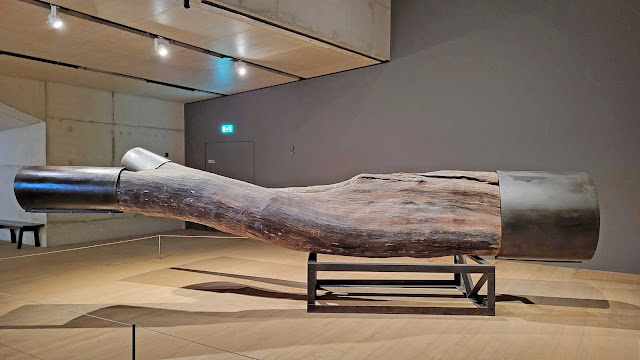
Magdalena Abakanowicz - Anasta


To my mind her Abakans are her triumph which are completely spellbinding.  It's a marvellous exhibition - on until 21 May 2023. 


Sunday, 5 February 2023

Stitched Postcards for York Embroiderers and Stitchers

Woven bee with knitted wire wings

I am a member of York Embroiderers and Stitchers who are a friendly group of stitch and textile enthusiasts of all levels of ability and experience. We meet monthly at Haxby Memorial Hall near York. Over recent months there has been a stitched postcard project that I chose to be part of. We have been split into groups of six and have made postcards for the other members of our group.  This means we have each made 5 postcards for group members. Now all of the postcards have been distributed I thought I would share with you the 5 postcards I made. The theme for the postcards was Wings which could be real, imagined or abstract.

My first postcard featured a handstitched bird inspired by Scandinavian folk art and uses backstitch, fly stitch, double cross stitch and chain stitch.  I'd designed this stitched postcard for a workshop several years ago. (You can read about it here.)  It was nice to stitch it again and choose different threads.

Handstitched Scandi Folk Art Bird Postcard

I tried to match my postcards stamps to the subject on the front where possible...

Bird stamp for a bird postcard

For my second postcard I chose an aeroplane for a different set of wings...

Plane Postcard

Here I handstitched onto a photocopy of a plane using fly stitch for the wings (very appropriate, I thought) and also included some machine stitching.  I managed to find a plane stamp too...

Plane stamp

My third postcard was for our December meeting and so it seemed appropriate to stitch an angel...

Angel postcard

This angel has an embellished body, sheer fabric sandwich wings, pewter charms, beaded hair on khadi paper painted with watercolours and torn envelope clouds plus a typewritten angel banner. I also managed to find an angel stamp...

Angel stamp

In January, we had to have something metal on our postcards so I decided to knit some wire wings for my bee...

Bee postcard
The bee has a woven body.  The background is watercolour on khadi paper with some handstitched flowers and a bit of swirly homemade felt and a bee stamp for the reverse...

Bee stamp

The final postcard for our February meet-up featured a felt butterfly, appliqued and embroidered on a watercolour painted khadi paper background, flying through some handstitched appliqued felt flowers...


Butterfly postcard

with a butterfly stamp on the reverse...

Butterfly stamp

And of course it wouldn't be the whole story if I didn't share with you the postcards I received....

Whitby Abbey at Halloween on hand-dyed fabric is the subject of Annie's postcard. Check out the bats...

Whitby Abbey - Annie Smith

A lovely combination of peach and grey stitching makes up Pauline's Nuthatch...

Nuthatch - Pauline Twyman

Nicky has produced a beautiful blackwork angel...

Angel - Nicky Brunger

Judith uses paint and stitch for this delicate butterfly and flowers postcard...

Butterfly & Flowers - Judith Johnson


Nadine made this super mixed media bee postcard with lots of info about the scissor bee which is the smallest bee species in Britain...

Mixed Media Bee - Nadine Paver


It was great fun to join in and it was all organised by the amazing Chris Beavers, one of our members.  You can see everyone's postcards here on instagram or facebook.  Why not get in touch and come and join YES?