Showing posts with label Turbine Hall. Show all posts

Monday, 24 February 2025

Mire Lee - Open Wound at Tate Modern Turbine Hall, London

Mire Lee - Open Wound
 

The current installation in the Turbine Hall at Tate Modern is Mire Lee's Open Wound (on until 16 March 2025).  The Turbine Hall is seen as an industrial womb in this installation where various "skins" - fabric sculptures suspended on chains - emerge from a machine coated with a liquid that drips from the machine's tentacles. Then they are moved to racks to harden before being added to the rest of the "skins" populating the Turbine Hall.  The installation is supposed to evoke images from both the textile industry and mining whilst also referencing the Turbine Hall's industrial past.

Mire Lee - Open Wound

The "skins" are drenched in a viscous liquid...

Mire Lee - Open Wound

Detail of a "skin"...

Mire Lee - Open Wound

Not sure whether this was the "skins" drying or being prepared to enter the machine...

Mire Lee - Open Wound

We are told Open Wound is supposed to remind us of a deserted construction site with "an atmosphere of futility and melancholy, where something has started to wither " whilst the "skins" are also supposed to "suggest an eerie solidarity".

Elsewhere in Tate Modern, I liked these by Petrit Halilaj.  These were large winged insects - moths - drawn to the lights.  He made these with his mother, Shkurte, using Kosovar fabrics and carpets. He wears them as costumes during performance pieces and often produces moth themed work. Apparently Halilaj used to chase moths around the house as a child.  His family home was destroyed in the Kosovo War (1998-99).  His work is bound up in memory and nostalgia... 

Petrit Halilaj - Do you realise there is a rainbow even if it's night!?

Petrit Halilaj - Do you realise there is a rainbow even if it's night!?


Petrit Halilaj - Do you realise there is a rainbow even if it's night!?


And the Catbus, which was part of Monster Chetwynd's installation - A Tax Haven Run By Women...


The Catbus is a character in Hayao Miyazaki's film, My Neighbour Totoro.  I wanted to climb aboard but it didn't look like that would be welcomed!

There's always something of interest at Tate Modern and apart from the special exhibitions, it's all free.  


Saturday, 16 March 2024

El Anatsui - Behind the Red Moon - Tate Modern Turbine Hall, London

El Anatsui - The Red Moon
 

El Anatsui - Behind the Red Moon is the latest Hyundai Commission on show in the Tate Modern Turbine Hall, London. El Anatsui was born in Ghana and currently works in both Ghana and Nigeria. His monumental sculptures are made up of thousands of bottle tops and fragments.

As you enter the Turbine Hall, descending the ramp, the first of three sculptures greets you.  This is The Red Moon which, we are told, looks like a billowing sail.  The circular Red Blood Moon element within the sail is made of bottle tops...

El Anatsui - The Red Moon (detail)


The reverse side looks like a large yellow sail...

El Anatsui - The Red Moon (yellow side)

The symbolism of the sails was to bring to mind ships and the transportation of goods and people across the globe.  Sailors would also sometimes use the moon for navigational purposes.  During the Transatlantic Slave Trade, enslaved African peoples were taken across the ocean to the Americas where they were sold or traded for goods such as gold, sugar, spirits and other commodities.  The bottle tops used in the piece come from modern commodities rooted in colonial industries, thus El Anatsui hopes to expose the connected histories of Europe, Africa and America through the use of waste from industries built on colonial trade routes.


The next piece you come to is The World.  From underneath and from the main gallery side it just looks like a series of fragments of knitted wire or wire mesh but when viewed from a particular point on the bridge all the fragments line up to look like the world.  The circular nature of this piece echoes the circular moon in The Red Moon.

El Anatsui - The World

El Anatsui sees fragments as a symbol of renewal and restoration with the capacity to reform.

El Anatsui - The World

El Anatsui - The World


The final piece is The Wall.  This is the largest piece and like The Red Moon, is double sided...

El Anatsui - The Wall

The side you first encounter is largely black and trails on the floor in folds. El Anatsui sees the black as symbolising Africa and its diaspora with a potential for homecoming and return.

El Anatsui - The Wall (detail)

The reverse side is brighter in colour....

El Anatsui - The Wall 

El Anatsui - The Wall (detail)

El Anatsui - The Wall (detail)

El Anatsui - The Wall (detail)

El Anatsui - The Wall (detail)

El Anatsui sees walls as both structures that constrain and encircle but also that hide things.  In hiding things, he thinks this may provoke curiosity which could be harnessed to overcome the constraining nature of the walls.

He sees the black and multicoloured nature of The Wall as symbolising the clash of global cultures and the hybrid identities that result.

The Wall and The Red Moon look like large patchwork quilts made from recycled metal pieces that are stitched together with wire.  As such, they could be taken apart and reconstructed to create different installations.  They are fascinating.  The wall is particularly interesting as you can get close to it to see how it has been made and what it is made up of. Anatsui works with a large team of assistants who work together to assemble the sculptures.

This exhibition is on until 14 April 2024.  Go see - definitely worth visiting!  


Sunday, 26 March 2023

Cecilia Vicuña - Brain Forest Quipu at Tate Modern Turbine Hall

Cecilia Vicuña - Dead Forest Quipu (detail)
 

Chilean artist & poet, Cecilia Vicuña, is currently exhibiting her Brain Forest Quipu in the Turbine Hall at Tate Modern, London.  Her installation references the Andean Quechua people's use of the quipu or knot, used instead of writing to record and remember things such as statistics, poems and stories.  Vicuña calls the quipu "a poem in space". They originated 5000 years ago and were banned after the European conquest in the 16th century. Many were burnt and destroyed at that time but their symbolism remains part of Andean culture today although the exact meanings behind their formations and colours is not now known.


Cecilia Vicuña - Dead Forest Quipu (detail)

Cecilia Vicuña - Dead Forest Quipu (detail)

Cecilia Vicuña - Dead Forest Quipu (detail)

This multimedia installation is an act of mourning for the destruction of the rainforests and its subsequent effect on climate change and the violence against indigenous peoples.  The installation comprises 3 elements. Firstly, two Dead Forest Quipu sculptures which are 27m textile pieces hanging from the ceiling.  These include different materials woven together with found objects, unspun wool, plant fibres, rope and cardboard. Then there is a Sound Quipu including indigenous music, silences, new pieces by Colombian composer Ricardo Gallo and field recordings from nature. And lastly a Digital Quipu which shows films of indigenous activists and land defenders from around the world who are using digital platforms to get their voices heard.


Cecilia Vicuña - Dead Forest Quipu (detail)

Cecilia Vicuña - Dead Forest Quipu (detail)

Cecilia Vicuña - Dead Forest Quipu (detail)

Some of the items included in the sculptures were collected from the banks of the River Thames by women from local Latin American communities.  This is typical of Vicuña's use of modest, imperfect found materials which she calls "precarios" (precarious)


Cecilia Vicuña - Dead Forest Quipu (detail)

Cecilia Vicuña - Dead Forest Quipu (detail)

The 
bone white colour of the sculptures evokes the bleached bark of trees killed by drought or intentional fire or other dried out substances like snakeskin.

Cecilia Vicuña - Dead Forest Quipu (detail)

I saw this when also visiting the Magdalena Abakanowicz exhibition - plenty of textile art on show to whet your appetite! 
The Cecilia Vicuna exhibition is on until 16 April 2023.


Thursday, 22 January 2015

Richard Tuttle - I Don't Know. The Weave of Textile Language - Tate Modern

 
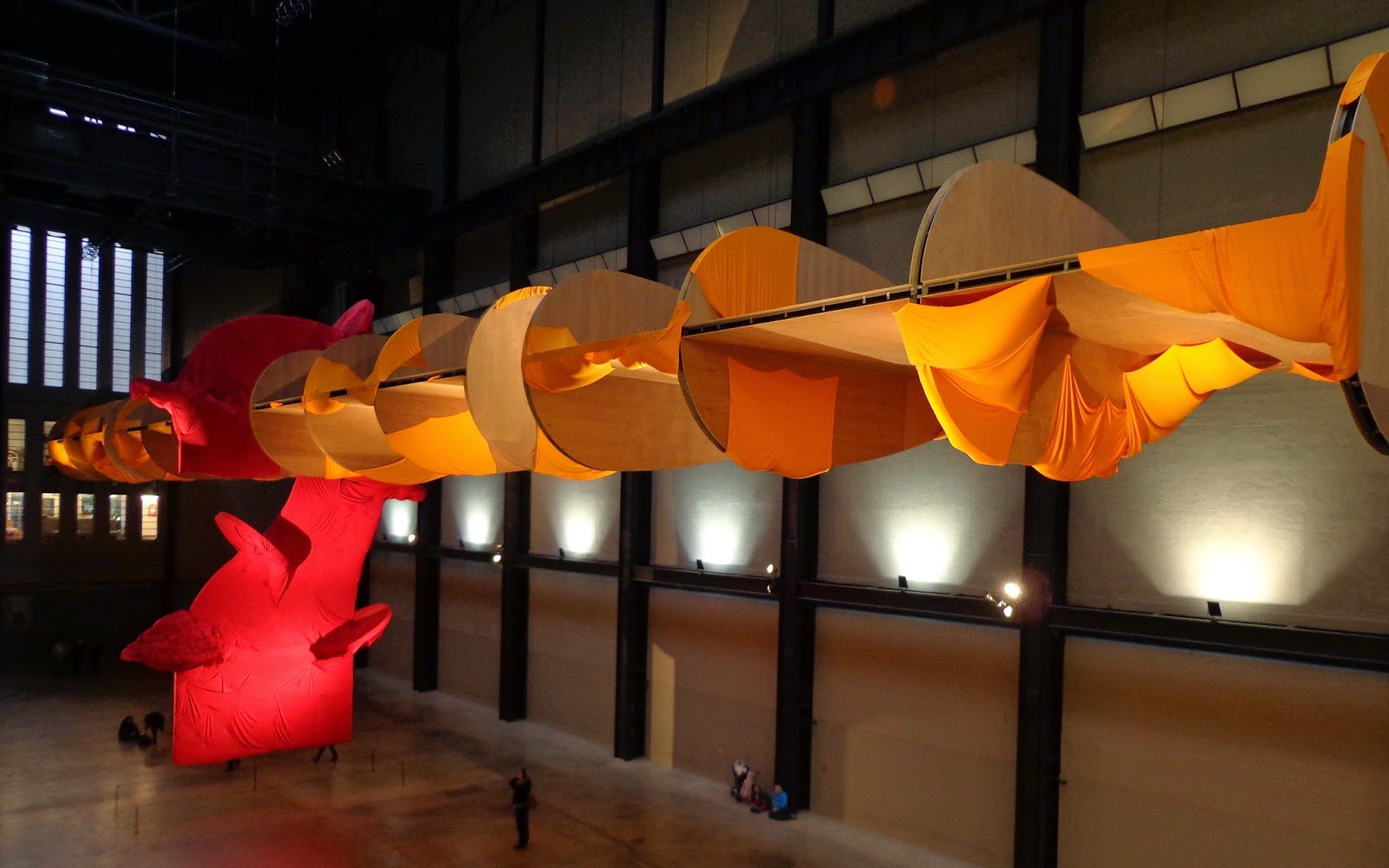
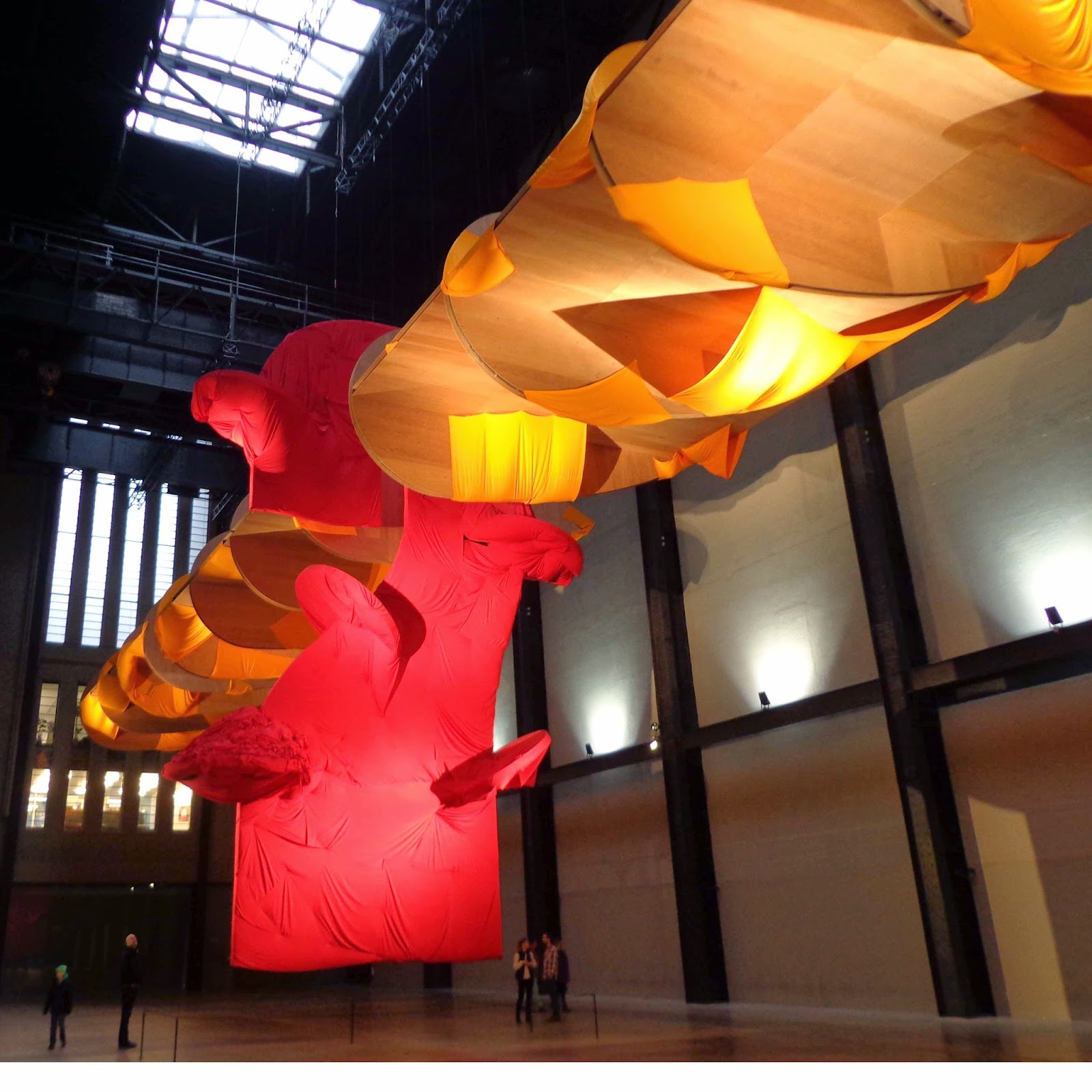
Richard Tuttle - Turbine Hall, Tate Modern, London

Currently exhibiting in the Turbine Hall at Tate Modern, London, Richard Tuttle is an Amercan artist for whom art is an adventure.  He is also a collector of textiles from around the world and is fascinated by weaving. He is interested in the different techniques and technologies that different cultures use to create their textiles.
 
Richard Tuttle - Detail of central section

This hanging structure is the largest sculpture Tuttle has ever made.  It uses about 2,500 sq metres of fabric hanging from a plywood frame 24 metres long and 12 metres high.  It looks like two wings separated by a large red covered structure.

Richard Tuttle

It is supposed to relate to Tuttle's memories of the Vietnam war (he had wanted to be a pilot until he realised his role would be to drop bombs) and to raise the issue of genocide in the 20th Century and to comment on the separation of the mechanical (e.g. large scale industrial textile production) and the human (e.g. "art-making").
 
Richard Tuttle


The three fabrics were woven by Garden Silks Mills Ltd in Surat, India.  They are a combination of natural and man-made fibres, dyed to the bright colours & textures specified by Tuttle.  I could see the red and orange/yellow fabric quite clearly.  I read there was some midnight blue too but I couldn't see it.

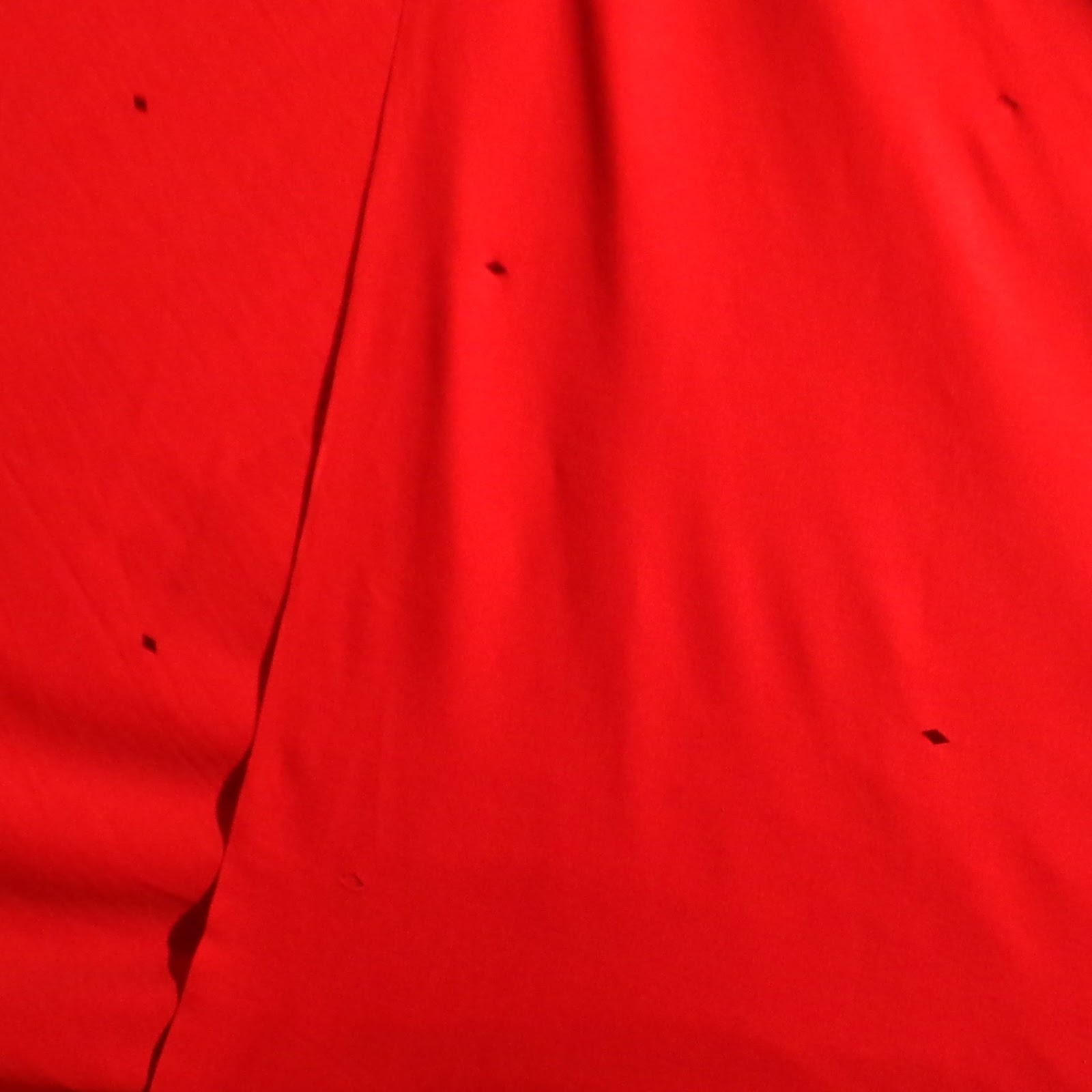
Richard Tuttle - Holes in the red fabric

When close up you can see that the red fabric has a pattern of small holes at regular intervals.

On until 6 April 2015, you can read more here.  I think, unusually, it's better in the photos than in real life.  Not quite as exciting as some of the other Turbine Hall exhibits but if you are in the vicinity, then take a look!