Showing posts with label Hannah Lamb. Show all posts

Saturday, 29 July 2023

Hannah Lamb - Fragment of a Dress Performance Piece

Jenny Skinner wearing Fragment of a Dress by Hannah Lamb after the performance
 

In 2022 the Bronte Parsonage Museum commissioned textile artist Hannah Lamb to create a piece for them.  That piece was Fragment of a Dress. Inspired by the museum's collection of small fragments of cloth associated with the Bronte family, especially Charlotte, and knowing that textiles and clothing are imbued with memories of special times in our lives, Hannah collected stories from museum visitors about items of clothing that they held dear. Each story took the form of a hand written note about the item and what it meant to them. Using these personal responses, Hannah and her students and colleagues stitched a series of embroidered panels onto silk organza, which Hannah then incorporated into the finished "Fragment of a Dress" which had a mid 19th century silhouette. It was on display at the Bronte Parsonage until the end of December 2022.

Here are some of the embroidered panels.  I would like to have seen what all the panels said.  I don't know if the panels were just a selection of the stories collected or all of them...


Hannah Lamb - Fragment of a Dress (embroidered panel detail)

Hannah Lamb - Fragment of a Dress (embroidered panel detail

Hannah Lamb - Fragment of a Dress (embroidered panel detail

On the 1 July 2023 in the Spinning Mill attic at Sunny Bank Mills in Farsley, Hannah & Jenny created a performance piece of the deconstruction of Fragment of a Dress, returning it to fragments.  The Spinning Mill attic is an empty space full of atmosphere...


Spinning Mill attic

Hannah's cyanotype prints of the embroidered skirt were on display and a soundtrack was playing in the background...


Hannah Lamb - Fragment of a Dress Cyanotype

Hannah Lamb - Fragment of a Dress Cyanotype


The dress, worn by Jenny Skinner, was cut into pieces by the audience.  This was achieved by Jenny handing a pair of scissors to each audience member, in turn, to cut a fragment after which Hannah stitched a certificate of authenticity onto each piece with her vintage hand operated sewing machine. Each fragment cutter could keep their fragment as a souvenir. The very first piece was cut by Hannah herself. She cut a sliver through several of the embroidered panels.  This seemed to give "permission" to cut a fragment however you chose.  Some cut slivers and some cut out whole embroidered panels.  These acts of deconstruction were filmed by Lucy Forrester of Proud Fox Studio.


Hannah Lamb's Vintage Sewing Machine


Hannah Lamb's Accoutrements

It was a very interesting performance - watching what people chose to cut and wondering what might become of the pieces.  I thought it was quite an act of faith on Hannah's part to see her beautiful and considered work "destroyed" in front of her (Hannah's use of the term "deconstruction" makes it seem less harsh).  I certainly found the responsibility of cutting into the piece a little unnerving.  I couldn't really concentrate on the soundtrack that was playing at the time and only caught "fragments" of what was being said.  I think it was the stories people had left her about their treasured clothing. 


Jenny Skinner & Hannah Lamb

A further performance happened later in the day.  I went to the first performance.  I particularly wanted to go to this as I hadn't been able to see the dress when it was on display at the Bronte Parsonage Museum.  I wanted to see it "whole" before it was deconstructed. I don't know if it is now completely "gone" or if there is more to fragment.  No doubt we will hear more from Hannah about its progress and I hope we will see the filmed outcome.   


I thought you might like to see the fragment I cut...

Fragment of a Dress: Fragment 3


I hope my fragment will go on to have a new life in something I make.


Tuesday, 27 June 2023

The 62 Group - Tailored - Sunny Bank Mills, Farsley, West Yorkshire


Sian Martin - Process (detail) & Hannah Lamb - Deconstructed Shirt (detail)

The 62 Group, a renowned textile art collective, are currently exhibiting at Sunny Bank Mills with an exhibition entitled - Tailored.  The work in Tailored explores multiple meanings and interpretations of the word itself and what it means to the individual artists’ practice. Some artists consider the process of making and elements of it; the design and weaving of cloth and the pattern, pinning, cutting and sewing of a garment. Other artists take a more narrative and personal approach to the meaning. The techniques used include stitch, knit, casting, drawing and film; sculpture and installation.  The exhibition is also a celebration of 10 years of culture at Sunny Bank Mills where cloth was produced that was used primarily in the making of suits.

I'm going to give you a whistlestop tour through some of my favourites...
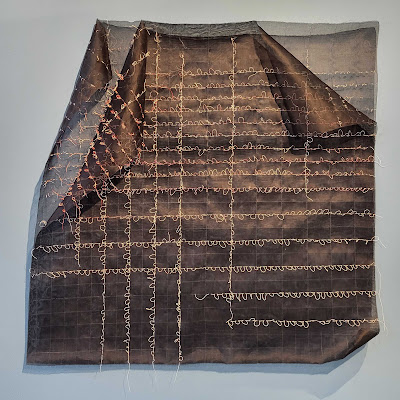
Sian Martin - Process

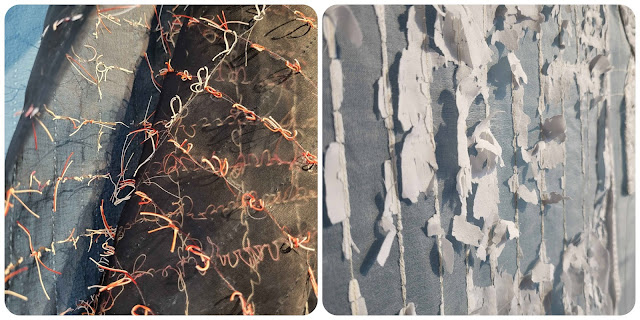
Sian Martin's Process (above & detail at top) is inspired by one of the mill workers at Sunny Bank Mills and Sians's own beginnings in dressmaking.  Sian was fascinated by tailor tacks and their ability to transfer marks through layers of cloth.  This piece celebrates those traditional dressmaking skills.   Also the repetitive and rhythmic stitching of this piece celebrates that stage in the process of making a tailored garment.
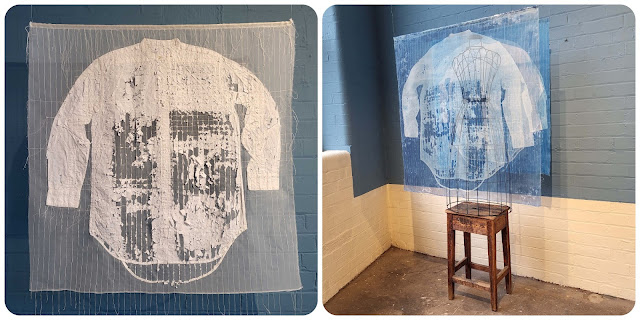

Hannah Lamb - Deconstructed Shirt & Dressing Up

Hannah Lamb's work is always interesting.  Taking a vintage man's shirt, with it's overtones of  masculinity, formality and appropriateness, Hannah has used a devore technique to deconstruct it and to question whether those overtones are valid or a camouflage behind which someone is hiding.  In Dressing Up, Hannah has developed this theme further using cyanotype imagery of the Deconstructed Shirt to suggest the different layers of our private and public selves.  The mannequin between the images offers a different body image playing with ideas of size, gender and identity.  Are we dressing to fit in or express our true selves?
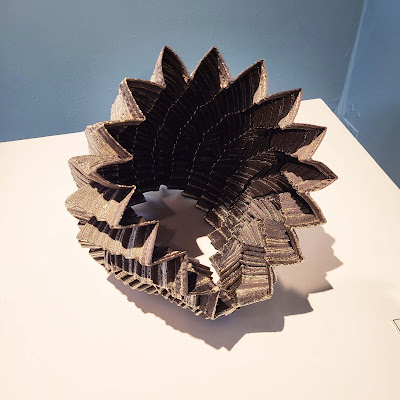
 

Hannah White - Fluidity & Rigidity: No 4 

Hannah White "tailors" her weaving into a customised, sculpted form using conductive threads and a process called electroforming. This creates a metal skeleton on the conductive threads around which the fabric folds. Hannah describes this as engineering with thread.  I don't pretend to know how this actually works but would like to know more about the process and even see it in action.  The results are impressive.
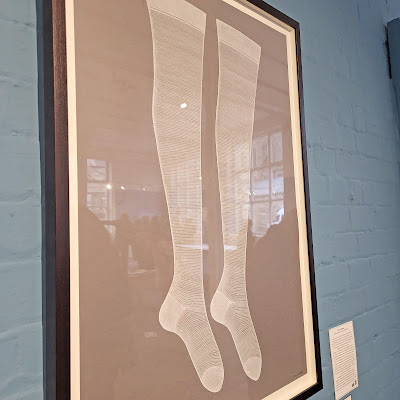

Teresa Whitfield - Woollen Stockings for the Mending Girl

Teresa Whitfield was inspired by a circular knitting machine at Sunny Bank Mills.  Typically they were used for knitting worsted stockings but the one here in Farsley was actually used for knitting dyed samples that would be used for the woven cloth.  Here she imagines it used for knitting some stockings for one of the female mill workers and wonders about their living and working conditions and the inequalities of the textile industry.  Her work is a drawing of knitted fabric.  Teresa sees a parallel between the repetitive and meditative act of drawing knitting and of the act of knitting itself.


Shuna Rendel - Thread in the Air (detail)


Shuna Rendel has the Asian tailorbird as her inspiration.  This small creature stitches together leaves using spiders' web or plant fibres to make a cradle for its nest.  Shuna has created a series of possible cradle variations using avocado skins, vine tendrils, gladioli sepals, vetch pods and waxed linen thread.
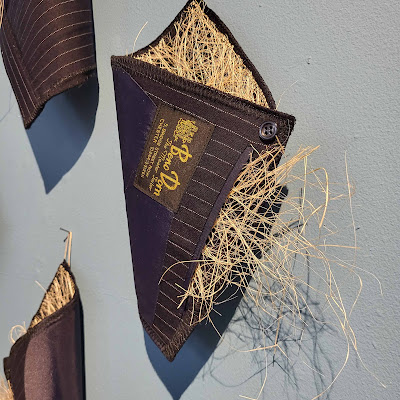

Ann Goddard  - Tailor-Made

Ann Goddard was also inspired by the tailorbird and by the bespoke clothing made by Master Tailors.  Both the bird and the Master Tailors create something that will blend into the environment of the user.  Here Ann used the pockets of a pinstripe suit, the fabric of which was similar to that woven at Sunny Bank Mills, as the cradle for the nest which is represented by the abaca fibre inside.  The suit used was made by Master Tailor Beno Dorn who btw made the first suits worn by the Beatles.

There are plenty of other interesting pieces in the exhibition.  This is just a small taster.  You'll have to be quick to catch this one as it closes on 2 July 2023.  Do go if you get the chance.

Sunny Bank Mills is a great place to visit.  Apart from the Gallery and shop on site, there are various cafes, a Scrap Shop, the Sunny Bank Mills Archive, artists studios, shops and more.  There's also plenty of car parking.

Tuesday, 6 June 2017

Lasting Impressions: Cloth Taxonomies at Salts Mill, Saltaire


You may remember that last year on a trip to the Saltaire Arts Trail, I took part in textile artists, Hannah Lamb & Claire Wellesley-Smith's Lasting Impressions project which you can read about here. To put you in the picture, we were asked to leave imprints of our clothing on small porcelain tiles and in doing so, to consider the value of cloth and clothing and to complete an information tag about the garment.  One year on, the artists were back in the Spinning Room at Salt's Mill, so I went to see how the project was developing.

The Lasting Impressions project laid out

The imprinted tiles had all been fired... 

Imprinted fired tiles

My tile, 234, bearing an imprint of my cardigan, was there too...

My tile is no. 234


The garment information collected on the tags last year, was being used to create a series of weavings.


Finished woven strips


The fibres identifed as making up the garments were selected and woven into fabric strips incorporating the information tag.
 
Table showing various fibres

 
Fibres

 
Fibres on cones to be selected for weaving


I worked on no. 27 and was given the tile and the tag in a cardboard box.  I had to weave a section of the fabric strip using the information on the tag.  It said that garment was made of viscose and polyester.  From the cones hanging above one of the tables I chose two strands of fibre - one viscose, one polyester, each about 2 metres long.  Next I threaded the tag onto the fibres so that it was in the middle of the length of fibres.


Tag 27


Table loom

Under instruction, I operated the table loom so the fibres and tag were incorporated into the woven strip of fabric.  A piece of red thread identified the start and end of my weaving.  Once my weaving was completed, the associated tile was stored away such that the tiles moved from drawers at one end of the display to the other end as their information was catalogued through the weaving process.  The loom was now ready for sometime to carry on and catalogue no. 28.


My completed weaving for garment no. 27 lies between the two lines of red thread

It was interesting to see the project develop and to be involved in this new stage.  Fibre content was the aspect Clare and Hannah had concentrated on, and the chosen method of development leant itself well to audience participation, also to exploring what the different textile fibres look and feel like and how woven fabric is made.  


What might be next?  They could explore the garments' country of origin, age or what people like about them.  Or perhaps they could scan the tiles and print out the textures on fabric and make some composite textural piece or country of origin based piece?  Who knows, we'll have to wait and see.


Tuesday, 14 June 2016

Lasting Impressions in the Spinning Room at Salts Mill, Saltaire

One of my recent trips was to the Saltaire Arts Trail where I visited The Spinning Room at Salts Mill.  Textile artists, Hannah Lamb & Claire Wellesley-Smith were there encouraging us to leave imprints of our clothing on small porcelain tiles and in doing so to consider the value of cloth and clothing.

Porcelain tiles

Every participant was given a porcelain tile and a numbered tag.  You left an imprint of your clothing by pressing it into the tile and numbering it to match your tag number.


My tile with an imprint of my cardigan

Then, on the tag, you gave some info about what garment it was, where it was made, what from, how long you'd had it and why you liked it.

Information tag

The tags were then hung up so you could read what people had said about their garments.  It was interesting to read through them.  Some people's clothing was special because of comfort and familiarity, practicality, where it had been bought, who had made it, or from remembering happy times when wearing it - a "material" representation of memory and experience.


Everyone's information tags

The tiles were stored in drawers until they could be taken away to be fired.

Imprinted porcelain tiles

As a reward for taking part, you could have a gold or silver stitch made on your clothing - one lasting impression in return for another.  Thanks to Hannah for my silver stitch!


Silver stitch on my cardigan - another lasting impression!

I am looking forward to hearing more about this project and where it is going next.  I'm sure we'll be hearing more about it soon.


Tuesday, 29 September 2015

Hannah Lamb at City of York Embroiderers' Guild


Hannah Lamb - Original Cyanotype Print

Recently Hannah Lamb came to both speak and give a workshop to the City of York Embroiderers' Guild.  Hannah is a textile artist living in West Yorkshire.  She is inspired by landscape particularly of her current home and her childhood home in rural Buckinghamshire.  Her work incorporates cyanotypes (a photographic process that produces a blue print), eco-printing (binding plant material in fabric or paper to stain and mark), stitching and the use of found objects.  She has looked at quietude as an antidote to stress and has "mapped" her walks as a personal response to the landscape working both in situ and through stitch.

Hannah Lamb - Linear Mapping Walk 4

Hannah led a workshop in decorative darning - a technique that allows time to think and stitch.  She talked us through the process, discussed the use of colour on our warp and weft threads and the sorts of threads we might use and then set us loose to experiment with a particular shape.  Here's my work:


My work from the Decorative Darning Workshop with Hannah Lamb
Darning in an embroidery hoop

Hannah gave us details about more complicated darning techniques we could try if we wanted to take things further.  I already have some ideas about how I should like to develop this technique for my own work - watch this space...