Sunday, 26 July 2020

New Acquisitions to the Quilters' Guild Collection


Quite some time ago (in fact it was back in 2018!) I went to the Quilters' Guild new acquisitions mini exhibition in the Guild HQ at St Anthony's Hall, York.  I came across my pics recently and thought you might like to see them.  Below are the acquisitions I liked best...

Jean Grimshaw - Berlin Wall Quilt - 2005

Jean Grimshaw's triptych incorporated fabric painting, photo transfer, applique, quilting & embroidery.  She was in Berlin in 1961 with her penpal when the Wall went up and her penpal's family were divided by it.  The quilt represnts Jean's feelings and experiences of Berlin and her joy when the Wall finally came down in 1989.

Val Jackson - The Lilac Dress - 2014

Val Jackson explores the role of women in the 1950s in The Lilac Dress. The text is taken from advice manuals and popular culture of the time.  It is heavily quilted and embroidered

Thirties Log Cabin Coverlet - Maker Unknown

Made from lots of different printed dress and furnishing fabrics, this log cabin coverlet has been hand sewn. 

Mosaic Coverlet with Art Nouveau Fabrics - Maker Unknown - 1880-1910

The back of this coverlet by an unknown maker features a number of Art Nouveau fabrics.

Corded Quilted Stomacher - Maker Unknown - 1730s

This stomacher features a floral design woked in backstitch.  Stomachers were popular in the 18th Century and filled the gap in the mid section between two edges of an open robe.

Other acquisitions included: The Muriel Rose Cot Coverlet - maker unknown (1930s), Betsy Cope's Irish Chain Quilt (1872), All the World's a Stage  - Linda Straw (1993), Applique Cot Coverlet - Mrs Routh (1890s-1900s), Child's Fabric Book - maker unknown (1920s - 1930s), Eiderdown Doll Quilts and Designs - Mary Morgan Lloyd (1930s).  You can find out more about them all here.

Open days and events at the Quilters' Guild Museum Collection will resume in 2021 - more info here.


Sunday, 19 July 2020

Rainbow Yarnstorm in Rowntree Park, York


Rainbow Yarnstorm in Rowntree Park, York

You may remember, back in April, I told you all about the Friends of Rowntree Park Craft Group's plans for a Rainbows for Rowntree Park Yarnstorm and how you could join in.  Well, thanks to everyone who did because the yarnstorm is now on display in the park and looks fantastic! The display is a big thank you to the NHS, carers, key workers and anyone who has helped others throughout the last few months.  The rainbows are also a celebration of the park itself which has been a special place for many, especially recently! And it's to celebrate the Park's 99th birthday.  Rainbows are a symbol of hope and in some ways that was why the Park was created -  to symbolise a hopeful future for the people of York.

Firstly, there's a truly magnificent gigantic rainbow yarnstorm on the tennis court fence.  It's a collage of knitted, crocheted and stitched squares.

Rainbow Yarnstorm Detail

On top of these squares there's extra interest added in the form of flowers and other stuff.  See if you can spot the frog, the car and the whale! 

Check out some of the extra decorations

It even looks good from the back...

Back View

Fun facts - did you know there are 86 red squares, 77 orange, 64 yellow, 55 green, 42 blue and indigo and 49 violet.  That's more than 370 altogether!  The whole display was made by over 40 people, from primary school age to over 90, from all over the city and further afield.

Rainbow Bench

You can even sit on the rainbow bench and have your photo taken which quite a lot of people were doing when I was there.  It seems to be proving very popular!

Lots of people like the yarnstorm

You can then move on to see the individual rainbows which are hanging in the arbour.  Here's a sneaky peak...

Rainbows in the Arbour

and a bit more detail...

Rainbows in the Arbour

Don't forget to take a look at the display board by the cafe...

Display board by the cafe

because there's alot of interesting rainbows and rainbow coloured pieces there too!

Detail from the Noticeboard

The Friends of Rowntree Park Craft Group hope to keep the yarnstorm up until the end of August so you've got plenty of time to take a look.  Why not take a pic of yourself with the rainbow and post it to social media with the hashtag #RainbowsforRowntreePark. 

Thanks to the Friends of Rowntree Park Craft Group and all who took part for such a fabulous display! 


Saturday, 11 July 2020

Benode Behari Mukherjee at David Zwirner, London

Benode Behari Mukherjee - Untitled

I thought you might like to see some of the Indian artist, Benode Behari Mukherjee's work which was shown earlier this year at the David Zwirner gallery in London.  Entitled "After Sight" it was a showing of the artist's collages from the 1950s and 60s after he had lost his sight.  Born blind in one eye and short sighted in the other, Mukherjee lost his eyesight completely in 1957.  This didn't stop his visual arts practice but inspired him to try tactile media too, such as sculpture but particularly collage, as well as drawing.

Benode Behari Mukherjee - Untitled

Mukherjee (1904-1980), a pioneer of Indian modern art,  studied at Kala Bhavana, the arts institute, in Santiniketan, West Bengal which was pre-eminent in modern art in 20th century India.

Benode Behari Mukherjee - Reclining Man

Mukherjee organised his collages by touch and chose the colours and subject matter from memory.

Benode Behari Mukherjee - Boy With Shell Nose

Mukherjee's collages were very colourful and vibrant.  His style reminded me of Matisse's cut-outs.

Benode Behari Mukherjee - Faces with Sutli

On another point altogether, the David Zwirner gallery has an impressive staircase.  Take a look...

Staircase at David Zwirner

Staircase at David Zwirner

Next time you're in London why not check out what's showing at David Zwirner?


Saturday, 4 July 2020

Solar Dyeing

Bottles for Solar Dyeing

You may remember that I had a go at natural dyeing with Rhubarb, Dandelions and Forget-Me-Nots a while ago.  Well, now I've had a go at solar dyeing.  This is the same sort of thing but takes much longer, is all done in bottles or jars and uses the sun as the heat source.  

Dandelion Bottle
In this bottle, I put the dandelion remains from my natural dyeing, some boiling water and a piece of calico fabric that had been mordanted with light soy milk.  A mordant is a dye fixative.  It helps bind the dye to a fabric to make it more colourfast and can affect the resulting colour. (The boiling water made the plastic bottle collapse a bit into a slightly bent shape)  After a couple of days, I topped the bottle up with some fresh dandelion heads and left it out in the sun for about 7 weeks.

Dandelion Mulch
Bottle with addition of fresh dandelion heads

Forget-Me-Not Bottle
This bottle had fresh Forget-Me-Not flower heads, some rusty screws and bolts,  hot water and unmordanted calico fabric.  After a few days I topped the bottle up with some distilled vinegar, gave it a shake and left it out in the sun also for about 7 weeks.  I added some linen yarn, that had been washed but otherwise untreated, about half way through.  I hoped the rusty screws and vinegar would act as a mordant here.

Fresh Forget-Me-Not Flower Heads

Dark Red Rose Petals & Leaves Bottle
Another bottle contained some dark red rose petals and rose leaves from the same plant, warm water and washed wool and linen yarns.  The yarns had been washed to remove any dressing.  This was left for about 5 weeks.  I thought the rose leaves might contain enough tannin to act as a mordant here.

Bottle with Rose Petals & Leaves

Red Onion Skins Jar
To this jar I added red onion skins, warm water and some washed wool & linen yarn.  This jar was left for 3 weeks.

Red Onion Skins Jar

Results
When I finally decided to empty all the bottles out, the dandelion mixture smelt terrible and had done very little...

Dandelion Results

The forget-me-not fabric and yarn had gone a nice grey colour with darker patches which I think this was largely due to the screws, bolts and vinegar...
 
Forget-Me-Nots With Screws & Bolts

The rose petals and leaves had produced a promising pale orange wool yarn and pink linen yarn...

Rose Petals & Leaves Results

whilst the red onion jar had the most vivid colours of all, with a deep orange wool yarn and deep pink linen yarn...

Red Onion Results

After getting everything out of the jars and rinsing off the plant matter, all the fabric and yarns were washed.  The yarns from the red onion jar needed most washing to get rid of the onion smell as I had put a few bits of onion in the jar with the skins.  After washing a lot of the vibrant colour had gone and none of the pink was left at all...
 
Dandelion Results


Forget-Me-Nots Results


Rose Petal & Leaf Results


Red Onion Results

You can see a small amount of the original fabric and yarn against the dyed results to show the change.  Apart from the dandelions, which I think were completely spent, all the results were interesting, although I was sorry to lose the pinks from the linen yarn from the rose petals and leaves and the red onion skins. All the linen yarns came out in different neutral shades from pale grey (Forget-Me-Nots) to beige (rose petals and leaves) to ivory (red onion skins).  The wool yarn was quite yellow from the red onion skins and much paler from the rose petals and leaves.

I have since bought a couple of books to find out more and hope to have better results in future!


Sunday, 28 June 2020

Loss, Rediscovery & Rearrangement - Romilly Saumarez Smith at the Harley Gallery

Squashed Coral Thimble - Romilly Saumarez Smith

This time last year (May 2019) the Harley Gallery, which is on the Welbeck Estate near Worksop, held an exhibtion - Loss, Rediscovery & Rearrangement by Romilly Saumarez Smith.


Pilgrim's Mirror Case With Whisk - Romilly Saumarez Smith

The exhibition title refers to jewellery and boxes Romilly Saumarez Smith has made from metal detecting finds that have lain beneath the ground for hundreds of years.  She envisages a new future for these pieces and because a neurological disorder means she can no longer do it herself, this vision is then brought to fruition by her asssistants - Lucie Gledhill, Anna Wales and Laura Ngyou.

Tree Handles - Calligraphic Tree - Romilly Saumarez Smith

These days, Saumarez Smith scours Ebay for her finds - medieval pins, Anglo-Saxon nails, watch winders, thimbles - and transforms them into contemporary treasure.

Tree Handles - Helianthus Tree - Romilly Saumarez Smith

I thought these pieces were exquisite.  It was by chance I came across the exhibition and I'm so glad I did!

Saumarez Smith was a Woman's Hour Craft Prize finalist in 2017.  You can hear her talking about her work here.

And just a word about the Harley Gallery which is not to be missed if you are in the neighbourhood.  It has interesting exhibitions, a good shop and there are places to grab a bite nearby.  Do go if you can - it is re-opening on the 1 August 2020!


Saturday, 20 June 2020

Ruth Asawa at David Zwirner, London

Ruth Asawa - Untitled - Hanging Sculptures - Different Wires

Earlier this year I visited the David Zwirner Gallery in London to see the Ruth Asawa exhibition - A Line Can Go Anywhere.  Ruth Asawa (1926-2013) was a Japanese American sculptor, educator and arts activist who grew up in California.  Her parents were farm workers.  Following the Japanese attack on the US naval base at Pearl Harbour, Ruth and her family were interned along with many other Japanese Americans.

Ruth Asawa and Her Wire Scupture 2 - Imogen Cunningham

After her release from internment, she studied at Black Mountain College in North Carolina. Here Asawa was taught by Josef Albers, Buckminster Fuller and the mathematician, Max Dehn.  She met many inspiring people at Black Mountain College, including Albert Lanier, an architectural student, who became her husband and with whom she had 6 children.

Ruth Asawa - Untitled - Hanging Sculpture (detail) - Galvanised Steel & Iron Wire
Ruth Asawa - Untitled - Hanging Sculpture - Steel Wire
During a trip to Mexico in 1947 a local craftsman taught Asawa how to create baskets out of wire.  She developed this technique to make her hanging sculptures which take on many shapes and forms. Later, inspired by nature, Asawa developed a new set of tied wire forms.

Ruth Asawa - Untitled - Wall Mounted Sculpture - Bronze Wire


Ruth Asawa - Wintermass - Hanging Sculpture - Stainless Steel Wire Tipped with Resin

Asawa was active in introducing arts education to local schools.  In 1968 she set up the Alvarado School Arts Workshop which brought professional artists into the classroom to teach art, gardening, music and theatre.  It spread throughout San Francisco's public schools.  In the 1980s, she founded a high school for the arts later renamed the Ruth Asawa San Francisco School of the Arts.  In 2009 Ruth's Table was founded in San Francisco to foster opportunites for older adults and adults with disabilities to express their creativity.

Ruth Asawa - Untitled - Freestanding Sculpture - Electroplated Copper Wire

Her wire forms are fascinating and had a look of knitted structures.  It was a great exhibition.


Saturday, 13 June 2020

Dyeing with Forget-Me-Nots

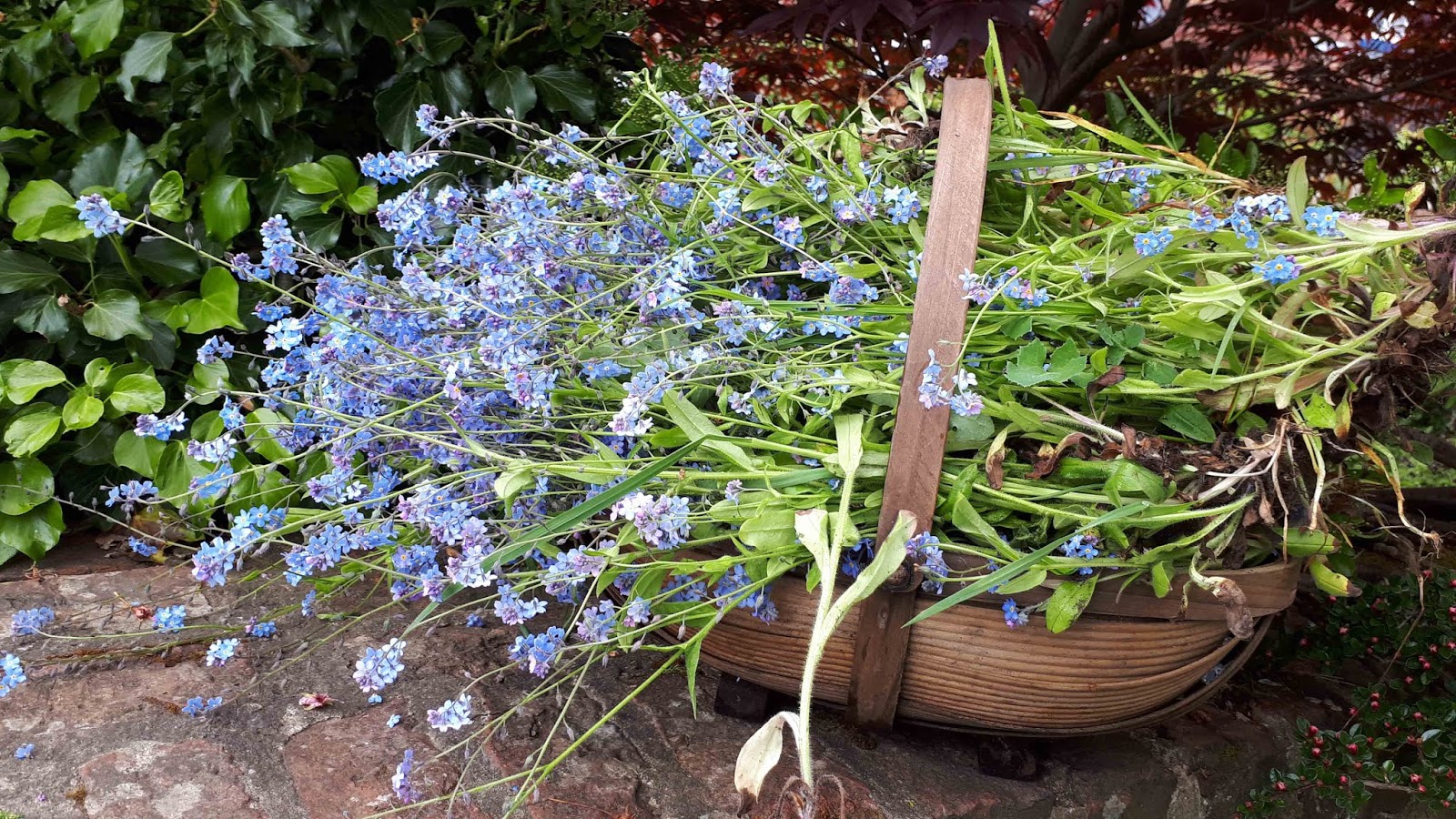
Basket of Forget-Me-Nots

Having had some success with my rhubarb leaf dyeing, and more limited success with dandelions, I decided to have a go with forget-me-nots as this is another plant that we had in abundance in our allotment...

Forget-Me-Nots in the Allotment

Having gathered them, I pulled the flowers off and added them to the dye pan. I had a little more weight in forget-me-not flowers than in fabric but not a lot and certainly not twice the weight of fabric in forget-me-nots which would have been ideal....

Forget-Me-Not Flower Heads in the Dye Pan

Dye Pan Flower Detail
The fabrics I chose to dye were some wool yarn, wool blanket and cotton calico.  They were soaked overnight in soy milk which I had read acted as a mordant for cotton fibres.  A mordant is a dye fixative.  It helps bind the dye to a fabric to make it more colourfast and can affect the resulting colour.  For example, mordants may intensify the dye colour.  Alum was recommended for wool but I didn't have any of that so I soaked them all in the soy milk (1 part soy milk to 4 parts water).  I could only get light soy milk.  I don't think this worked as well as ordinary soy milk would have.  I dried the fabric before putting it in the dye bath.

Fabric to Dye

To make the dyebath, I covered the forget-me-nots with water and simmered them for an hour and then removed the plant matter by straining. 

Sieve of Plant Material to be Discarded

The remaining liquid formed the dyebath to which I added the dry fabric.  My pan was aluminium as this was all I had. Ideally you would use a non reactive pan made out of stainless steel.   I simmered the dyebath for about an hour, during which I added a few rusty nails as nothing much seemed to be happening.  I thought this might help as you can use iron as a mordant too.  The recipe for an iron based mordant involves soaking some iron objects in 2 parts water to one part vinegar solution for a couple of weeks until it goes a rusty orange colour so this intervention was unlikely to have a great effect.

Dye Bath & Fabric

I left the dyebath to cool overnight...

Dye Bath After Cooling Overnight

The following day I rinsed out the materials, washed them and hung them up to dry.  Here are the results together with a little sample of the original fabric to show the colour change...

Before and After Dyeing Results

I was hoping for a blue colour and when the dye pan started heating up the water was very green so I thought a greeny colour might be a possibility.  However, the outcome was very similar to that of the dandelion dyeing which frankly, was a little disappointing. I may have overheated the dyebath which resulted in a more neutral colour than expected. I would also probably have got a better result if I'd been more careful with the mordanting process and used more forget-me-not heads.

Forget-Me-Not Dyed Items

The forget-me-not yarn and blanket were slightly paler in colour than the dandelion dyed pieces and the calico was very similar in colour bit a slightly different shade...

Wool Yarn

Wool Blanket

Calico

Not sure yet what I shall use the fabric and yarn for but interesting to experiment.  Why not have a go with some of your abundant plants?